TL;DR
Google AI Mode SEO rewards clear answers, strong entities, crawlable pages, and content that helps AI systems cite a source with confidence. Brands should update priority pages with concise definitions, comparison tables, schema, internal links, and monitoring workflows for AI-driven visibility.
Google AI Mode SEO has moved from a future concern to a live visibility problem for founders, ecommerce teams, local businesses, and marketing managers. SERP research for this topic found 110 results and competitor articles averaging 2,743 words, which shows a crowded field but also a need for a clearer, more practical guide. Search engine optimization: the practice of improving the visibility and performance of websites and web pages in search engine results pages. For teams that need faster execution, Earlyseo helps turn AI-search requirements into publishable content and technical actions.
Table of Contents
What is Google AI Mode SEO?
Google AI Mode SEO is the practice of shaping pages, entities, and site structure so Google's AI-powered search experience can understand, summarize, and cite a brand. It still depends on crawlable content and classic SEO signals, but it places more weight on answer clarity, source confidence, topic coverage, and follow-up search intent.
AI Mode changes the search session from a list of blue links into a conversational answer path. A query can produce a direct explanation, supporting links, related prompts, and deeper follow-up answers without forcing a new search.
Key insight: the page that wins may not be the longest page. The page that wins is often the clearest source for a specific answer.
Generative search also raises the quality bar. A 2023 paper on generative AI in Business & Information Systems Engineering examined how generative systems create new content from learned patterns. For SEO, that means vague pages are easier poorly, while structured pages give AI systems cleaner evidence.
Core terms for AI search visibility
- AI Mode: Google's AI-forward search experience that can answer complex queries and support follow-up exploration.
- AI Overview: a generated summary that may appear inside a standard Google results page.
- Citation: a visible source link or referenced page used to support an AI answer.
- Entity: a clearly identifiable person, brand, product, place, concept, or organization.
- Answer block: a short, direct passage that answers a question in a self-contained way.
How does AI Mode differ from AI Overviews and classic search?
AI Mode differs from AI Overviews and classic search because it makes the generated answer the main experience rather than an add-on to standard results. Classic SEO still matters, but rankings, snippets, citations, and engagement can be mixed into a more conversational search path.
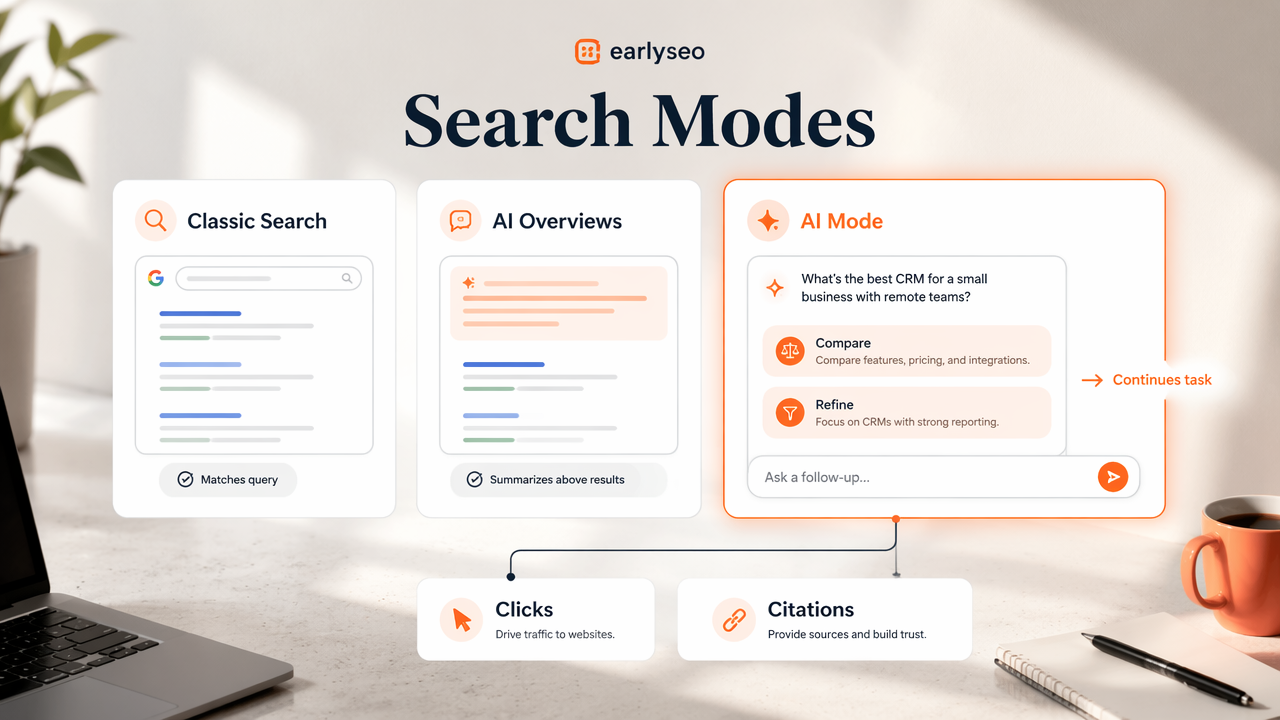
Classic Google results usually reward pages that match a query and earn clicks. AI Overviews summarize selected information above or within those results. AI Mode goes further by letting the user continue the task through follow-up questions, comparisons, refinements, and decision-style prompts.
Search experience comparison
| Search format | Main user experience | SEO priority | Best content format |
|---|---|---|---|
| Classic Google results | Ranked links and snippets | Rankings, titles, links, crawlability | Complete pages with strong metadata |
| AI Overviews | Generated summary inside results | Extractable answers and trusted sources | Definitions, steps, FAQs, evidence blocks |
| Google AI Mode | Conversational AI-led search | Citation-worthiness across a task | Structured answers, comparisons, entities, follow-ups |
The biggest shift is task coverage. A page about "local SEO pricing" may need to answer cost ranges, service types, timelines, risks, and vendor selection because AI Mode can connect those subtopics in one session.
Research on uncertainty in deep neural networks explains a wider AI concern: models can be uncertain even when they produce confident outputs. For publishers, that makes source clarity, dates, authorship, and evidence more important than clever wording.
What changes for small businesses
- More zero-click exposure: AI answers may satisfy simple searches before a click happens.
- More brand comparison moments: AI Mode can compare products, services, and local options directly.
- More need for source consistency: names, locations, categories, and services should match across pages.
- More value in niche authority: small sites can win narrow answers when content is specific and well structured.
For teams publishing through WordPress, the Earlyseo WordPress integration can support faster page updates when definitions, FAQs, and internal links need to be refreshed across a content library.
How should pages be optimized for AI Mode?
Pages should be optimized for AI Mode by giving Google a clear answer, a clear entity, and a clear reason to cite the page. The strongest pages combine classic SEO basics with answer-engine formatting: direct definitions, short paragraphs, tables, schema, internal links, and updated examples.
A strong AI-search page should not read like a keyword essay. It should behave like a reliable reference that solves a query, then supports the next question.
A practical optimization workflow
- Map the task behind the query. Identify the decision, comparison, or action the searcher is trying to complete.
- Write a 40 to 60 word answer first. Place it directly under the relevant question heading.
- Add entity-rich context. Name the brand, product, service, location, category, and standards where relevant.
- Use tables for comparisons. Make tradeoffs easy to extract.
- Add schema and clean metadata. Help crawlers understand page type, organization, product, FAQ, and article details.
- Link related pages internally. Show topical depth without stuffing one page.
- Refresh dated claims. Label old statistics by year and remove unsupported numbers.
For ecommerce sites, structured product category pages matter because AI Mode may compare options before a shopper lands on a store. The Earlyseo Shopify integration is relevant when product-led content needs cleaner titles, descriptions, and category support.
Content elements AI systems can quote
| Element | Why it helps | Example use |
|---|---|---|
| Definition block | Gives a clean extraction target | "Technical SEO: the process of..." |
| Comparison table | Helps AI summarize tradeoffs | AI Mode vs AI Overviews vs classic search |
| Numbered process | Matches "how to" intent | 6-step audit workflow |
| FAQ section | Captures follow-up prompts | "Can small sites appear in AI Mode?" |
| Internal link cluster | Shows topical relationships | Link AI search pages to SEO basics |
Medical AI research offers a useful parallel. The 2023 Nature paper Large language models encode clinical knowledge studied how large language models handle domain knowledge. SEO content is lower stakes than medicine, but the same broad lesson applies: specific, well organized knowledge is easier for AI systems to evaluate than loose commentary.
A dedicated machine-readable guidance file can also help AI crawlers interpret site priorities. Early adopters can review the Earlyseo llms.txt resource for a practical way to think about AI-facing site instructions.
How should brands monitor Google AI Mode visibility in 2026?
Brands should monitor AI Mode visibility by tracking cited pages, brand mentions, query coverage, and changes in organic traffic together. A single ranking report is no longer enough because AI search can expose a brand without delivering the same click pattern as classic results.
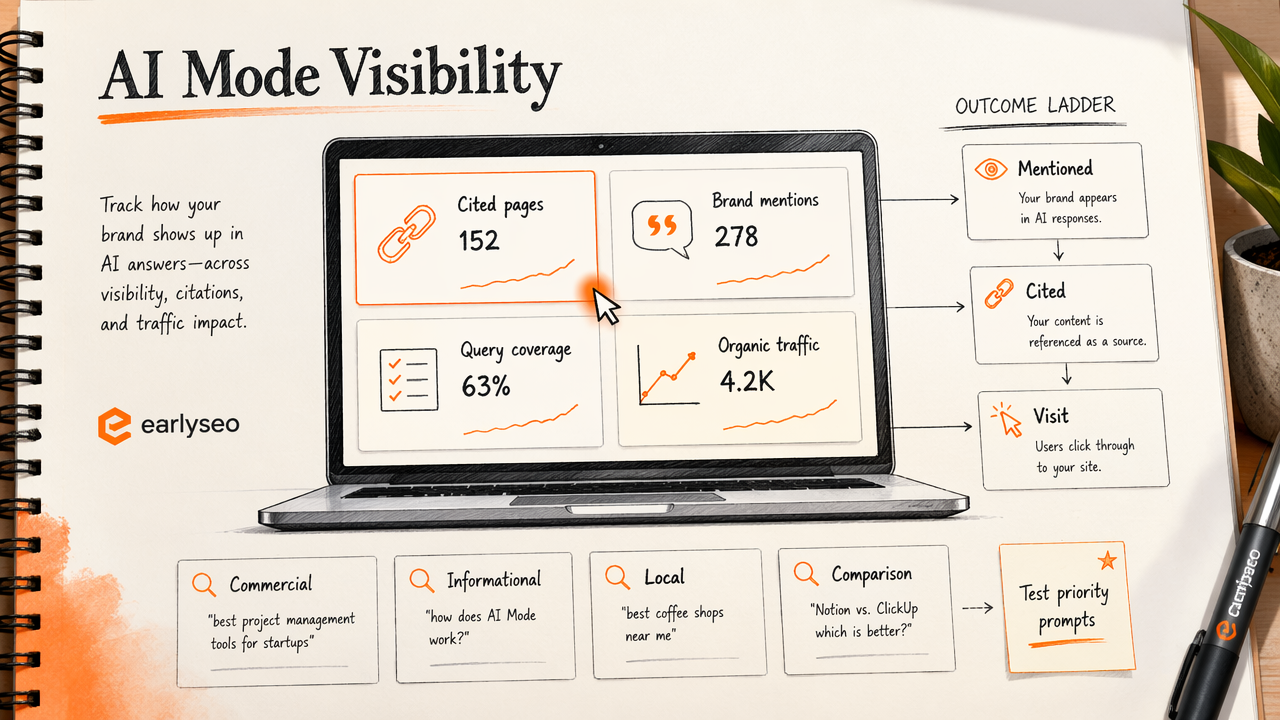
Measurement should separate three outcomes: being mentioned, being cited, and earning a visit. A brand can appear in an AI answer without a click, or receive clicks from deeper follow-up prompts rather than the original query.
A 2026 monitoring checklist
- Track priority prompts: test commercial, informational, local, and comparison queries.
- Record citations: note which pages AI Mode uses as visible sources.
- Watch brand wording: check whether the brand, product, and category are described accurately.
- Compare with Search Console: look for impression shifts, click changes, and page-level patterns.
- Review competitors: identify pages that get cited when a brand does not.
- Update pages monthly: refresh answer blocks, FAQs, schema, and internal links.
Search behavior is moving toward longer tasks, not just shorter answers. The content hub at Earlyseo blogs is useful for teams building a broader AI-search reading list around SEO fundamentals, content workflows, and visibility strategy.
Signals worth tracking by business type
| Business type | AI Mode visibility signal | Page to improve first |
|---|---|---|
| Startup | Brand category accuracy | Homepage and comparison pages |
| Local business | Service plus location mentions | Location and service pages |
| Ecommerce store | Product attributes and alternatives | Collection and product pages |
| B2B company | Use-case citations | Solution and case-study pages |
| Publisher | Topical source mentions | Guides and glossary pages |
The Earlyseo platform fits teams that need a repeatable way to publish AI-ready SEO content without turning every update into a custom project. The better operating habit is simple: treat AI visibility as an editorial, technical, and measurement workflow, not a one-time content rewrite.
FAQ: Google AI Mode SEO questions
Google AI Mode SEO questions usually focus on citations, traffic loss, content structure, and whether smaller sites can compete. The short answer is that AI Mode does not replace SEO basics, but it changes which parts of SEO need more precision.
Can small websites appear in Google AI Mode?
Small websites can appear in Google AI Mode when they provide the clearest source for a narrow question. A small local plumber, niche ecommerce store, or startup can compete by publishing specific service pages, original examples, strong FAQs, and consistent entity information across the site.
Does AI Mode replace traditional SEO?
AI Mode does not replace traditional SEO because Google still needs crawlable pages, useful content, internal links, and reliable site signals. The change is presentation. Pages now need to rank well enough to be considered and be structured clearly enough to support generated answers.
What content format works best for AI citations?
The best format for AI citations is a page with a direct answer near the top, followed by structured evidence. Definitions, comparison tables, numbered steps, FAQs, schema, and recent examples all help. Thin pages with vague claims are less useful because they give AI systems fewer reliable extraction points.
How often should AI Mode content be updated?
Priority pages should be reviewed monthly or quarterly depending on search value and market speed. Fast-moving topics such as AI search, ecommerce platforms, and local ranking changes need more frequent updates. Evergreen service pages can follow a slower schedule if facts, offers, and internal links remain accurate.
Conclusion
Google AI Mode SEO rewards the same businesses that make search easier to understand: clear pages, named entities, useful comparisons, reliable technical signals, and fresh answers. The next action is practical: pick five high-value queries, rewrite each target page with a direct answer block, add one comparison table, strengthen internal links, and monitor citations monthly. For teams that want a faster operating system for this work, Earlyseo can help structure the process. More guidance is available on earlyseo.com.