TL;DR
Solo consultants and coaches should rank with offer pages, proof-rich case studies, local or industry landing pages, and focused FAQ content instead of generic weekly blogging. The best 2026 SEO plan targets buying intent first, then builds authority with practical articles that answer client problems.
Search visibility can become a quiet referral engine for solo experts when the site matches how buyers search. SEO for consultants and coaches works best when it connects a clear niche, a paid offer, proof, and search intent. The Earlyseo platform can help small teams organize those pages, monitor content opportunities, and turn scattered expertise into a search-friendly site structure.
SEO for consultants and coaches: the practice of optimizing a personal service website so prospects can find specific offers, answers, case studies, and local or industry expertise through Google, AI answers, and other discovery tools.
Key insight: consultants and coaches do not need hundreds of posts. They need pages that prove who they help, what problem gets solved, and why the offer deserves trust.
Table of Contents
What is SEO for consultants and coaches?
SEO for consultants and coaches is a focused way to help expert-led service businesses appear for searches tied to problems, services, industries, and locations. It combines offer pages, clear expertise signals, case studies, FAQs, internal links, and technical basics so search engines and AI systems can understand the business and recommend it.
This field has deep roots. Early SEO practitioners included consultants such as Jill Whalen, an Ashland, Massachusetts based former SEO consultant, speaker, and writer. The modern version is more structured because search engines now evaluate entities, experience, topical relevance, and user satisfaction.
A 2022 paper in Small Business Economics examined small business resilience during the COVID-19 pandemic and focused on owner-managers, a reminder that small firms often need practical, adaptable marketing systems rather than giant campaigns source. For independent experts, SEO fits that need when it is tied to real services and sales conversations.
Core terms that shape the strategy
- Service intent: searches from people comparing, hiring, or requesting help, such as "executive coach for founders."
- Problem intent: searches around pain points, such as "how to reduce founder burnout."
- Authority content: articles, guides, and explainers that prove expertise without chasing broad traffic.
- Local intent: location-modified searches, such as "business coach in Austin."
- Entity signals: clear names, credentials, services, industries, locations, and linked profiles that help search systems identify the expert.
Which pages should a consultant or coach build first?
A consultant or coach should build the homepage, offer pages, case studies, FAQ pages, and authority articles before investing in broad blog content. This order reflects how buyers evaluate expert services: relevance first, proof second, details third, and thought leadership after the core site can convert.
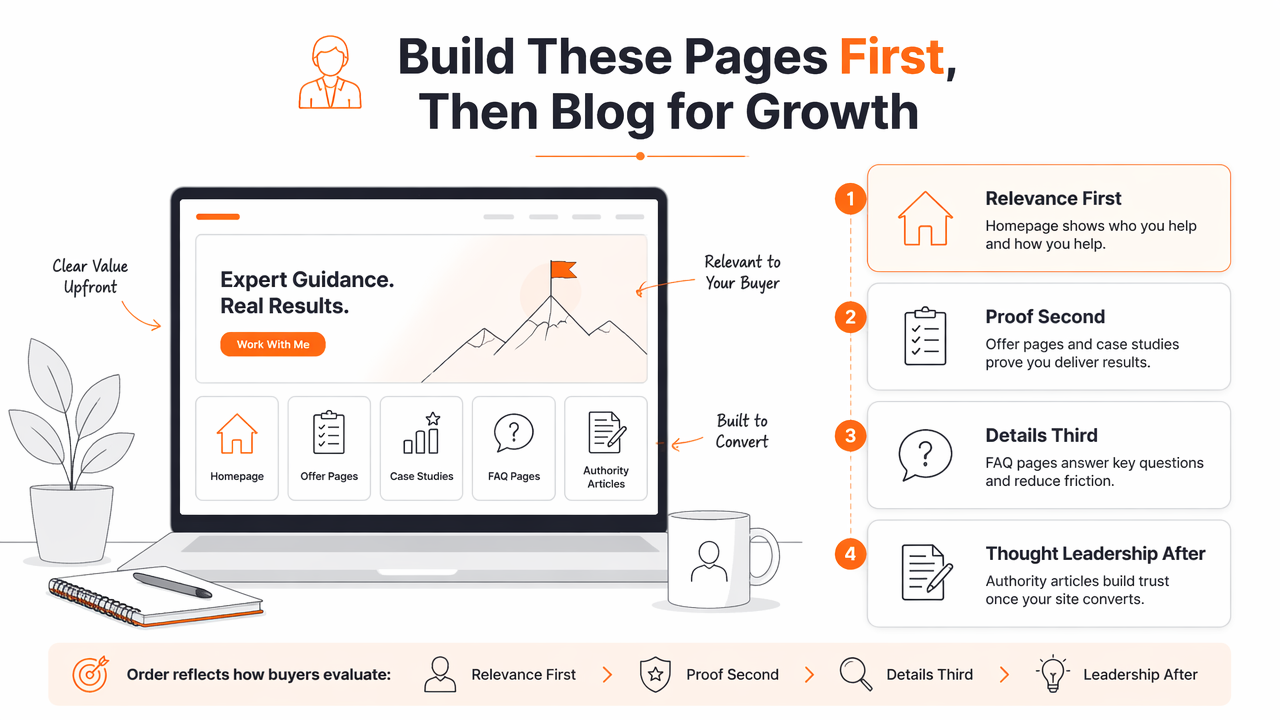
Generic posts like "10 leadership tips" rarely separate one expert from another. A better page plan maps to commercial questions, sales objections, and the language prospects already use during calls. Documentation habits also matter; teams using a clear publishing workflow can keep page titles, meta descriptions, schema, and updates consistent through resources such as the Earlyseo documentation.
Recommended page structure for solo experts
| Page type | Primary search target | What it must prove |
|---|---|---|
| Homepage | Brand, broad specialty, trust | Who the expert helps and what outcome is offered |
| Offer page | Service searches | Scope, process, fit, pricing cues, next step |
| Industry page | Niche searches | Familiarity with a market, role, or business model |
| Location page | Local searches | Service area, local relevance, contact details |
| Case study | Proof searches and sales support | Before state, intervention, result, client context |
| FAQ page | Objection and AI answer searches | Clear answers to pricing, timelines, fit, and method |
| Authority article | Problem searches | Useful insight connected to the paid offer |
The homepage should not carry every keyword. Its job is to make the positioning obvious. Offer pages can carry terms like "sales consultant for SaaS startups," while case studies show lived proof and articles answer related problems.
Strong site architecture makes a small website feel complete. Five excellent pages can beat fifty vague posts when every page has a clear job.
A simple publishing sequence
- Write the homepage around the primary niche and main outcome.
- Create one offer page for each paid service, not each vague skill.
- Add two case studies that show a real starting point, action, and result.
- Build an FAQ page from sales-call questions.
- Publish authority articles only after the offer pages have internal links.
For WordPress sites, the WordPress integration from Earlyseo can fit into a lightweight publishing flow, especially when a solo expert needs fewer manual steps between draft, optimization, and publication.
How should keywords be chosen for expert services?
Keywords should be chosen by buyer intent, not search volume alone. Consultants and coaches should prioritize phrases that name the service, audience, problem, industry, or location because those searches reveal stronger commercial fit than broad educational keywords.
Search intent matters because coaching and consulting decisions involve trust. A visitor searching "marketing consultant for Shopify store" is closer to action than someone searching "what is marketing." The keyword may have fewer searches, but the page can speak directly to the buyer's situation.
Keyword buckets worth targeting
- Service plus audience: "leadership coach for new managers," "pricing consultant for SaaS."
- Problem plus expert: "consultant for high churn," "coach for imposter syndrome at work."
- Industry plus service: "operations consultant for dental practices."
- Location plus role: "career coach in Chicago," "business consultant near Denver."
- Method plus outcome: "EOS consultant for leadership teams," "OKR coach for startups."
Each bucket should map to a specific page. Service terms belong on offer pages. Problem terms often become authority articles with clear links back to services. Local terms need location proof, not just a city name inserted into a title.
How to avoid thin or generic SEO content
Thin content happens when pages target a phrase but do not answer the buyer's real concern. A coach can rank for "executive coach for founders" only if the page explains the founder context, common problems, coaching process, proof, and fit criteria.
Better content usually includes:
- A direct answer in the first paragraph.
- Named industries, roles, tools, or frameworks.
- A practical process with clear steps.
- Evidence from case studies or client scenarios.
- FAQs that answer buying objections.
Earlyseo can help identify where a site has content gaps, but the expert still needs to supply the lived perspective. Search systems can detect generic sameness, and buyers can detect it even faster.
How can consultants and coaches build authority in 2026?
Consultants and coaches can build authority in 2026 by publishing proof, defining their methods, earning relevant mentions, and making expertise easy for search engines and AI systems to extract. Authority is no longer only about links; it also depends on clear entities, consistent claims, and useful answers across formats.
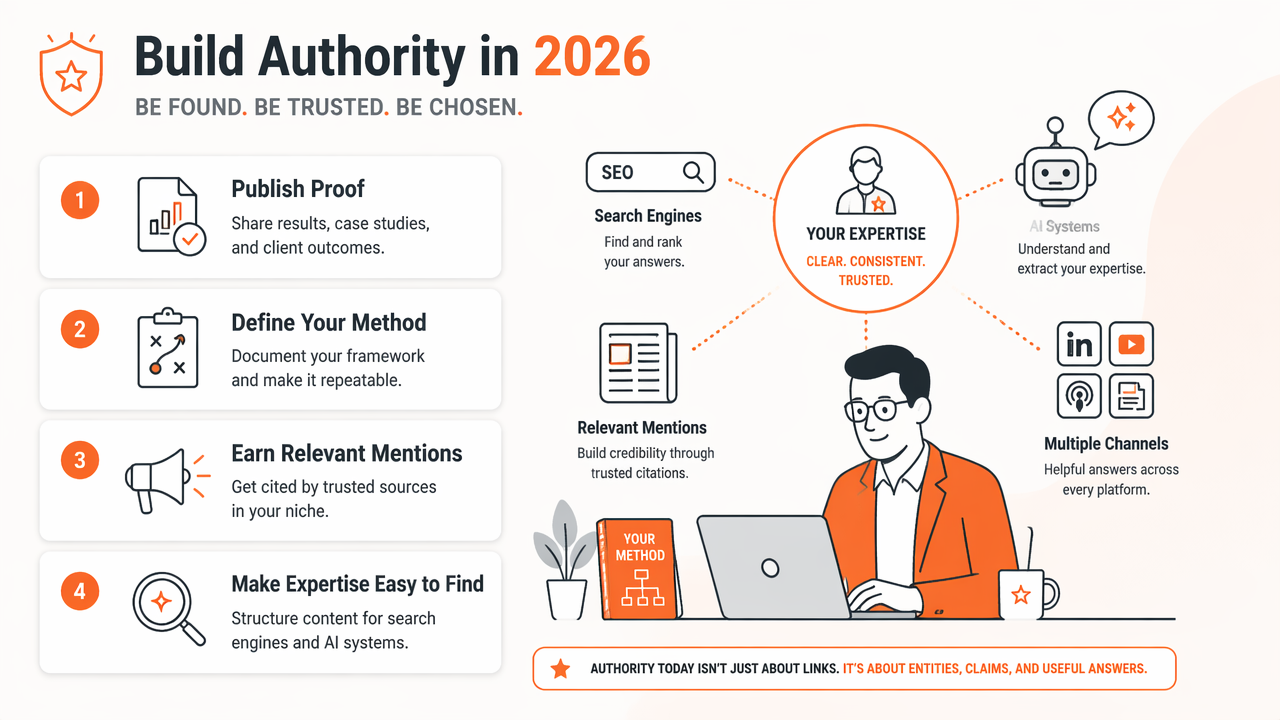
Competitor pages in the current SERP often cover keyword research, on-page basics, local SEO, LinkedIn profiles, and backlinks. The missing piece is a tighter connection between offer validation and content strategy. If the offer has not sold, SEO may amplify uncertainty instead of demand.
Authority signals that help both Google and AI answers
| Signal | Why it matters | Practical example |
|---|---|---|
| Named method | Makes expertise memorable | "Founder Reset Coaching Framework" |
| Case studies | Shows applied experience | A before and after client story |
| Credentials | Supports trust | Certifications, speaking, publications |
| FAQs | Feeds answer engines | Pricing, timeline, fit, process |
| Clear bios | Builds entity recognition | Name, role, niche, location, profiles |
| Internal links | Clarifies topical relationships | Article linking to offer and case study |
AI-driven discovery also makes machine-readable context more useful. Publishing clear policy, content, and AI-access files can help crawlers understand site intent. Early adopters can review the llms.txt guidance from Earlyseo to prepare for answer-engine visibility.
What to expect in 2027
Search discovery will likely keep shifting from blue links toward summarized answers, comparison panels, and AI-assisted recommendations. Expert-led sites will need more extractable facts: who the expert serves, what the offer includes, what evidence supports it, and how the method differs from alternatives.
Authority articles should become more specific, not longer for the sake of length. A focused article on "how fractional CFO consulting helps inventory-heavy Shopify stores" can send stronger signals than a broad finance guide. Teams that need an editorial rhythm can use the Earlyseo blog workflow as a place to manage practical, search-led publishing instead of random topic ideas.
FAQ about SEO for solo experts
Common SEO questions from consultants and coaches usually come down to timing, scope, and return. The right answer depends on the offer, niche clarity, and sales process, but the same principle applies across most expert-led businesses: optimize the pages closest to revenue before chasing large informational traffic.
Does SEO work for new consultants and coaches?
SEO can work for new consultants and coaches when the offer is clear and the niche is narrow enough to target specific searches. A new site should not expect fast results from broad terms. Better early targets include service-plus-audience phrases, local terms, and problem pages that connect directly to a paid offer.
How long should a coaching or consulting SEO plan take?
A practical plan usually starts with page structure, keyword mapping, and on-page improvements before content volume increases. Timelines vary by competition, site age, and niche. The first milestone should be better relevance and clearer conversion paths, not only rankings. Search growth becomes more durable when publishing supports a validated offer.
Should a consultant focus on local SEO or national SEO?
A consultant should focus on local SEO when proximity, referrals, or regional trust influence buying decisions. National SEO fits online coaching, niche consulting, or industry-specific services. Some experts need both: a local homepage and location page, plus national offer pages that target a role, industry, or problem.
How many blog posts does a coach need for SEO?
A coach does not need a fixed number of blog posts. A small set of high-quality authority articles can outperform frequent generic publishing. The better target is coverage: each core offer should have supporting articles, FAQs, and proof pages that answer the questions prospects ask before booking a call.
Conclusion
SEO for consultants and coaches should start with commercial clarity: a defined niche, a proven offer, pages that match buyer searches, and proof that reduces hesitation. The next best step is to audit the site against the page structure above, then publish one missing offer page, one case study, and one FAQ set before adding more articles.
For a lighter workflow, Earlyseo can help organize SEO tasks around the pages that matter most. Head to earlyseo.com after the core offer and audience have been defined, then turn that expertise into search pages built for both Google and AI discovery.